
Capacity planning that respects geography
Hospital Density & Physician Coverage AnalysisPlanning
Project overview
STATUS: LIVE — projects.gerber.ca/hospitaldensity/
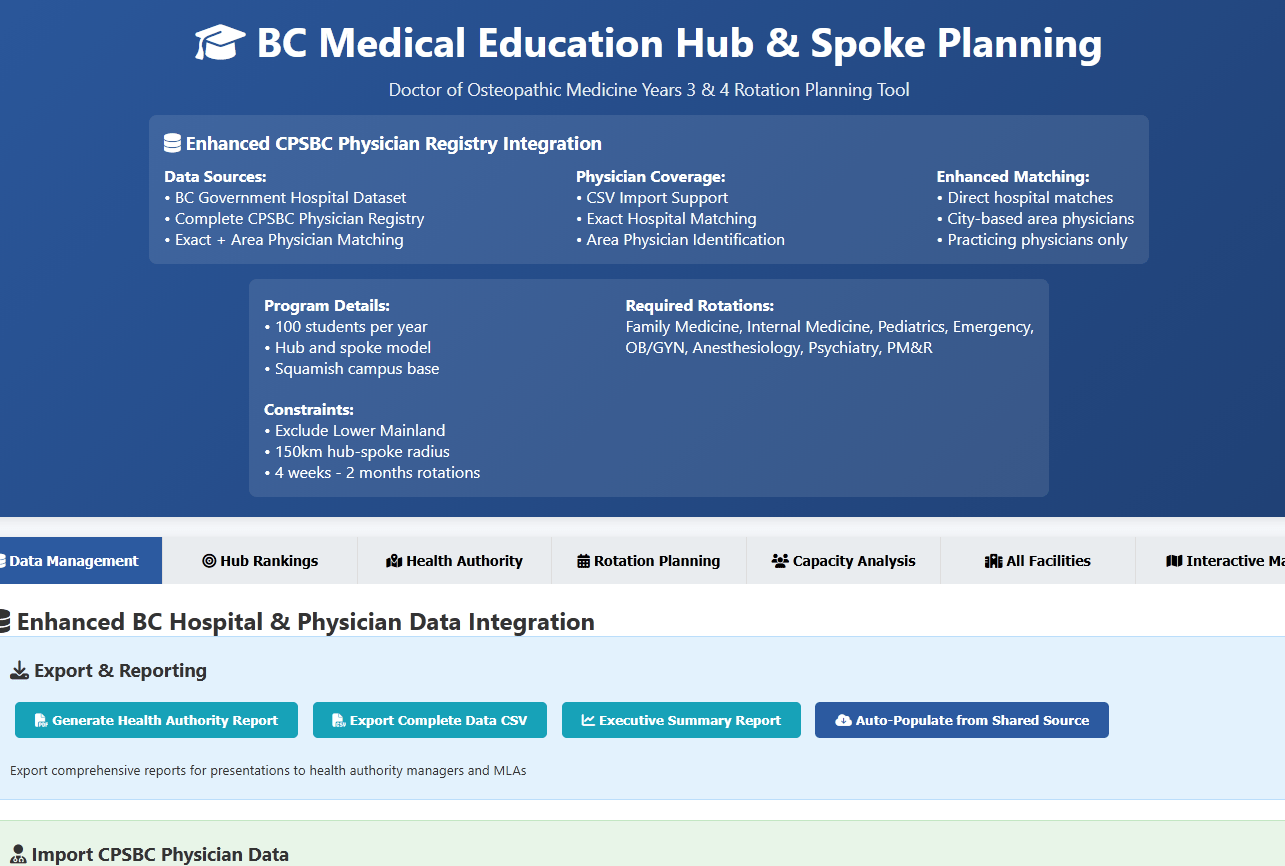
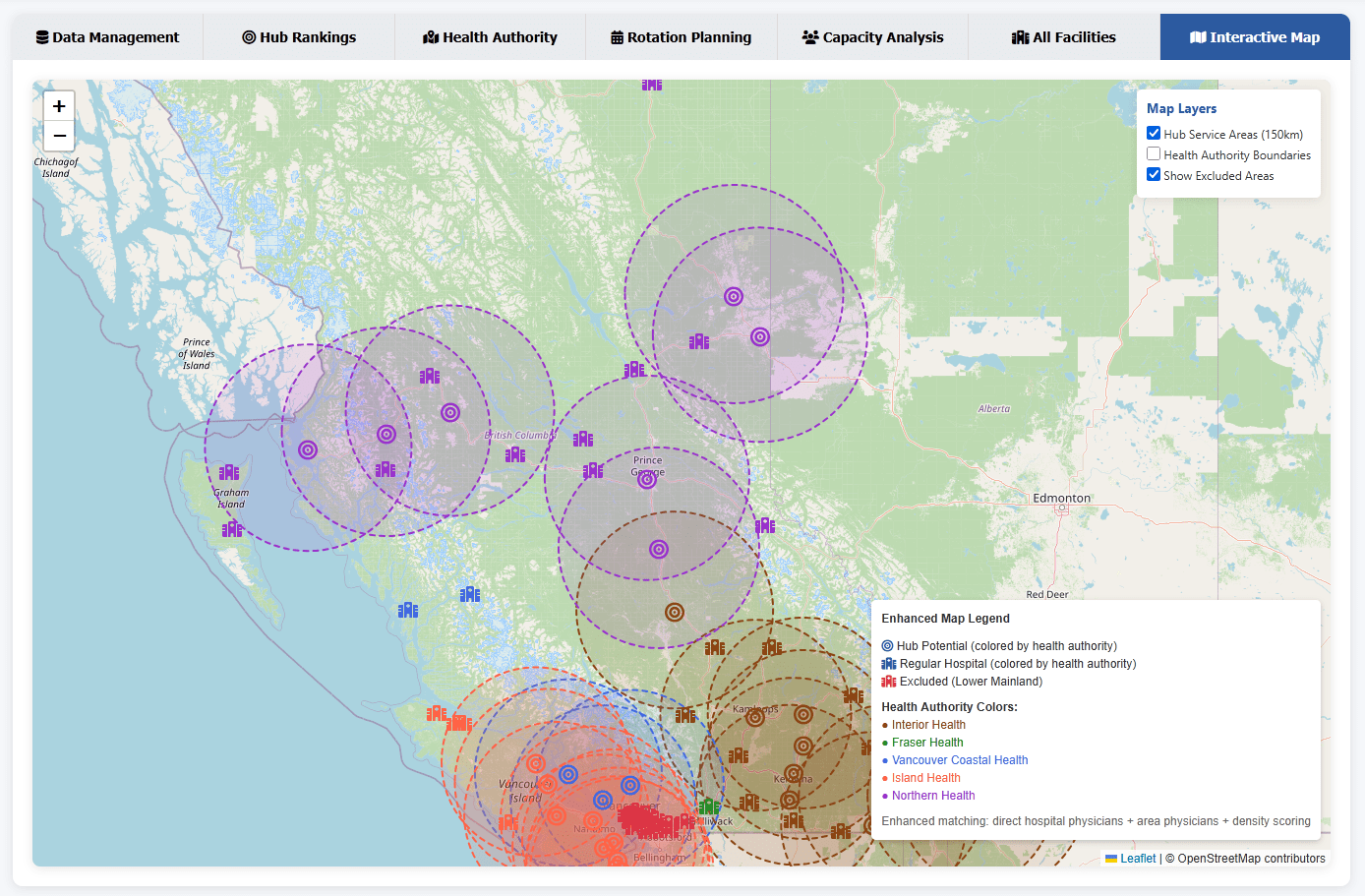
Training capacity isn’t only about seats. It’s about sites, coverage, and feasibility across distance. This tool integrates BC hospital data and physician registry information to make coverage patterns easier to see and discuss.
Overview:
- Problem: Planning clinical education models requires a clearer picture of physician availability around hospital sites.
- Build: A dataset-driven analyzer supporting direct hospital matching and city-based “area physician” logic, filtered to practicing physicians.
- Who it helps: Planners and leaders exploring hub-and-spoke models, rotation feasibility, and reporting needs.
The Problem
One of the most time-consuming and error-prone aspects of planning medical education programs — and specifically the hub-and-spoke clinical rotation models that graduate medical training depends on — is mapping physician availability against hospital capacity across BC’s geography. The data exists: the College of Physicians and Surgeons of BC (CPSBC) maintains a physician registry, and the provincial government publishes a licensed hospital dataset. But those datasets live in separate formats, use inconsistent naming conventions, and require significant manual reconciliation before they can be used for planning decisions.
For a province with significant rural and regional health authority complexity — and for a program like Canada’s proposed first Doctor of Osteopathic Medicine that needs to demonstrate clinical training capacity across diverse sites — the inability to rapidly model physician coverage around specific hospitals is a genuine planning bottleneck. It slows down program development, introduces risk into accreditation submissions, and makes it difficult to answer the core question regulators ask: can you actually train students at these sites?
The Solution
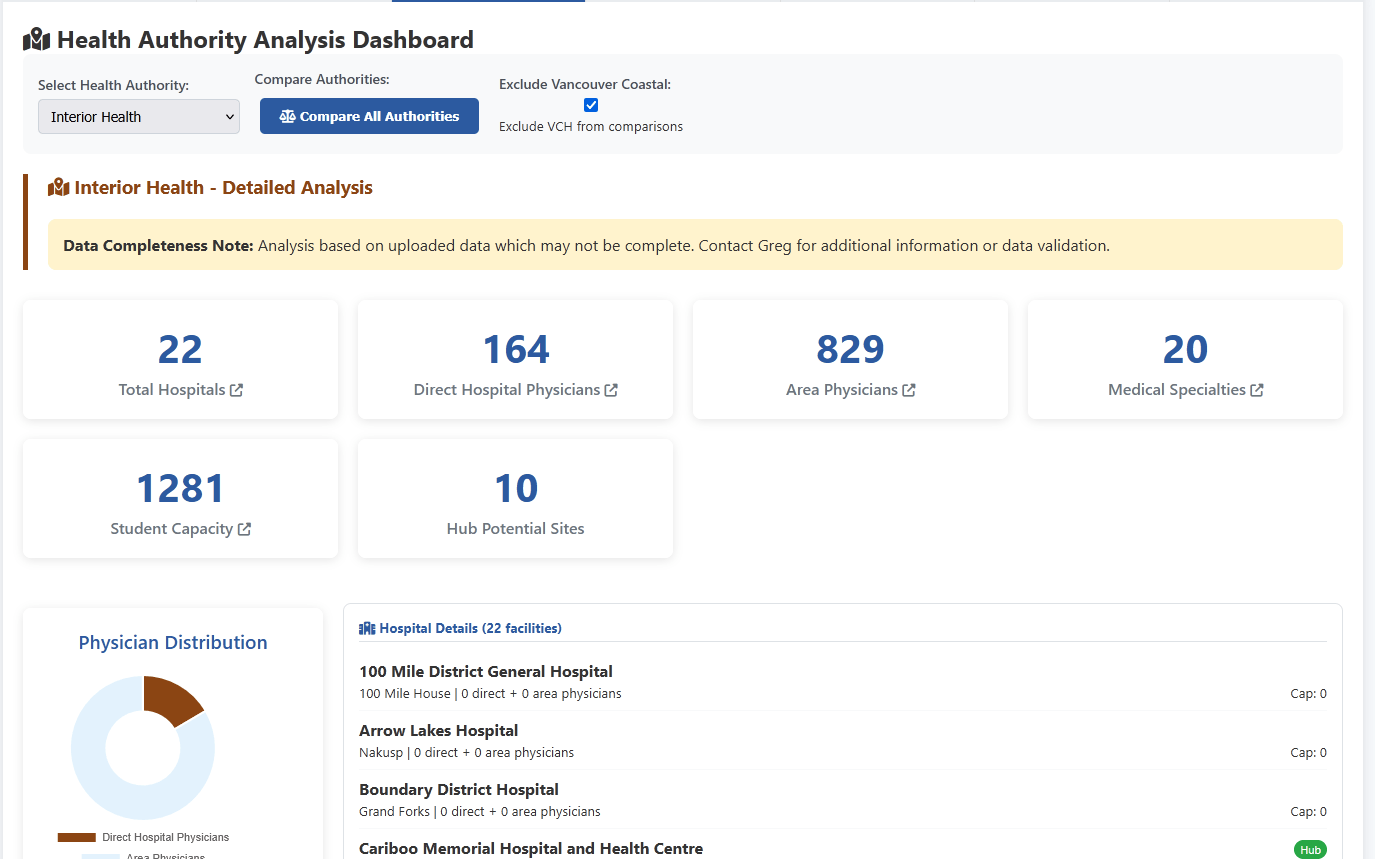
An integrated browser-based analysis tool that ingests the CPSBC physician registry (via CSV upload) alongside the official BC Government licensed hospital dataset, then applies a two-tier matching algorithm to calculate physician coverage for any hospital in the province. The matching logic operates at two levels: direct exact matching — physicians explicitly associated with a specific facility by name or address — and city-based area physician identification, which expands coverage estimates by surfacing all active registered practitioners in the same city as a hospital. Filters ensure only currently practicing physicians are included in density calculations. The result is a comprehensive, queryable view of physician availability at and around any BC hospital, exportable for use in program planning documents, site feasibility assessments, and regulatory submissions.
Who Uses It
Developed initially to support the program development and partnership work for Canada’s proposed first Doctor of Osteopathic Medicine program, where demonstrating geographically distributed clinical training capacity is a central accreditation requirement. Also applicable to any graduate health professions program — medicine, occupational therapy, nursing, physiotherapy — conducting hub site analysis or rotation feasibility work across BC’s health authority regions.
What Changed
What previously required hours of manual spreadsheet reconciliation — cross-referencing physician registry entries against hospital addresses, filtering for active practitioners, and assembling coverage summaries by site — now takes minutes. More importantly, the tool surfaces coverage patterns that manual analysis tends to miss: clusters of specialists in adjacent cities who aren’t formally affiliated with a given hospital but represent available supervisory capacity. That second-order insight has directly informed site selection decisions in program planning work.
Key features:
- CSV import support for registry and hospital datasets.
- Exact hospital matching plus “area physician” identification.
- Filters for active/practicing physicians for cleaner planning assumptions.
External link: View tool (public URL).

HsopitalTool
Hosptial Density Map
HospitalDistrictDepth
Live
02


0 Comments